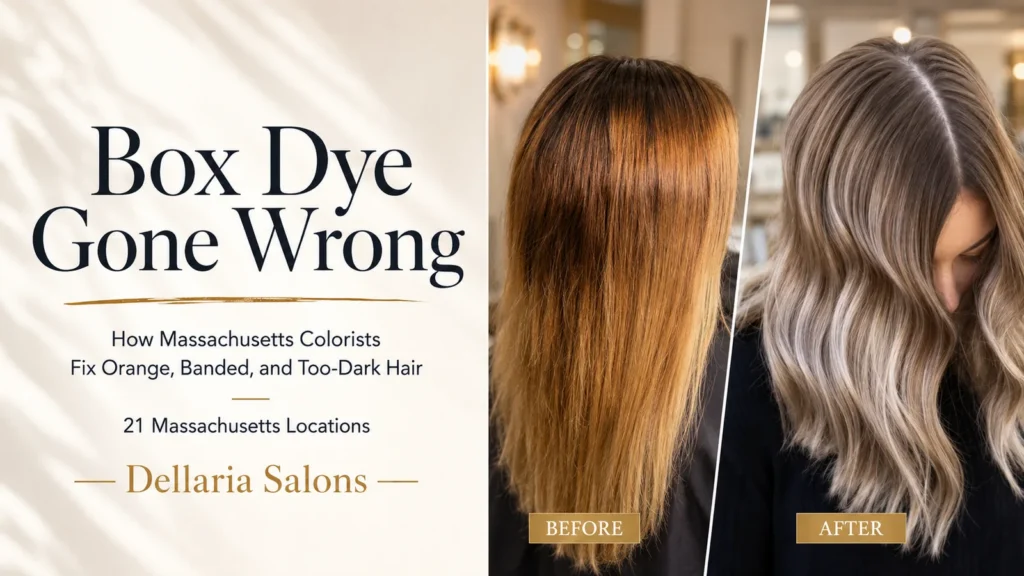
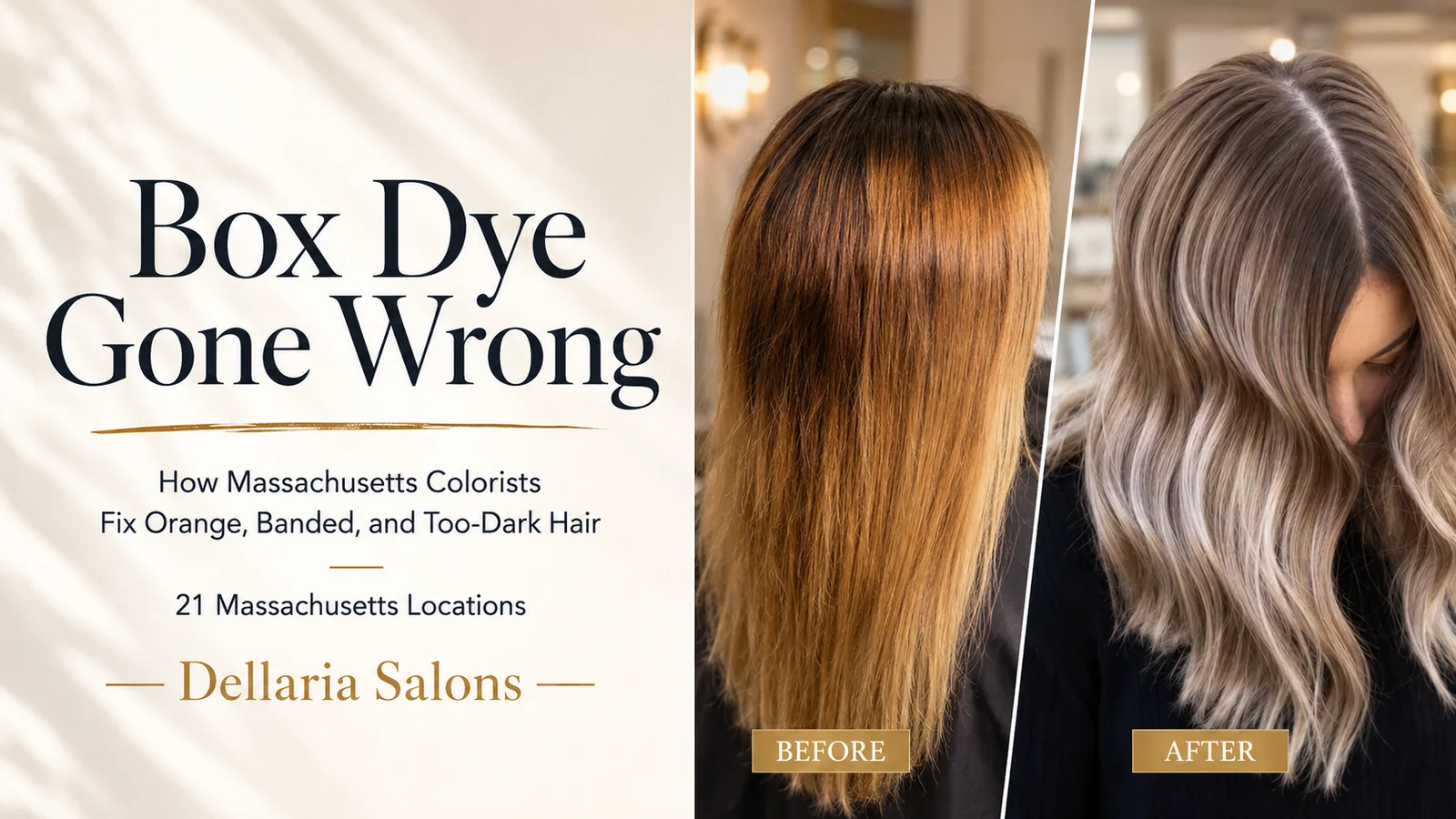
Somewhere between the Fourth of July and Labor Day, a lot of very reasonable people buy a box of hair color. The appointment was three weeks out. The roots were showing before a wedding. The sun had turned the ends a shade nobody asked for. So the box came home from the pharmacy, and now you are googling how to fix box dye hair at eleven o’clock at night.
Here is the good news: almost none of this is permanent, and almost none of it is your fault. At-home color is engineered to work on the widest possible range of hair with the least possible skill — which is exactly why it behaves so strangely on your specific hair. Below is what actually goes wrong, why the fix is not another box, and what a real correction looks like when you sit down in the chair.
Why late summer is peak season for at-home color
Three things stack up in August across Massachusetts. Salt water and chlorine have been lifting and roughing up the cuticle since June, so color that was perfectly balanced in May now reads brassy. Sun exposure lightens the hair around your face faster than the rest, which makes regrowth look worse than it is. And school, work, and fall calendars come back all at once, so suddenly there is a reason to look pulled together and no time to wait.
That combination — faded, uneven, and in a hurry — is precisely the moment a box of color looks like a good idea. It is also the moment it is most likely to go wrong, because you are applying pigment on top of hair that is already porous and inconsistent from a summer outdoors.
The four things that actually go wrong with box color
1. It turns orange or brassy
This is the most common complaint we hear, and it is not because the color was defective. When any color lightens your hair even slightly, it has to travel through your hair’s underlying warm pigment — red, then orange, then gold — before it reaches a neutral place. Professional formulas control that with a toner or gloss placed at the end. A box does not know how dark you started, how porous your ends are, or how much warmth needs to be cancelled, so it frequently stops in the orange zone and leaves you there.
2. It bands into stripes
Banding is what happens when color gets applied over color, over color, over several rounds. The roots take one way, the mid-lengths that have been colored twice take another, and the ends that have been colored four times take a third. In natural light you can see the horizontal stripes. Nothing is wrong with your hair — you are simply looking at a timeline of every application, stacked up.
3. It went too dark and will not wash out
Permanent color deposits artificial pigment inside the hair shaft, and artificial pigment does not shampoo out. That is the whole point of it. Going darker is easy and going back is not, because reversing it means lifting that deposited pigment back out — a process that has to be done in controlled stages if the hair is going to survive it. This is the single most common reason someone books a correction consultation.
4. Hot roots
If your roots came out noticeably brighter, warmer, or more orange than the rest, you have hot roots. Your scalp gives off heat, so color processes faster and lifts more at the root than it does two inches down. Colorists compensate for this with timing and formula placement. A single-formula box applied root to tip cannot.
Why a second box makes it harder, not easier
The instinct is to buy a darker box to cover the orange, or an “ash” box to cancel it out. Please do not. Every additional application adds more artificial pigment to hair that already has too much, and darker or ashy formulas sitting on porous ends tend to grab unevenly and go muddy, grey-green, or nearly black in patches. What was a one-appointment problem quietly becomes a multi-session one.
There is one more reason to stop, and it matters: some at-home and progressive color products contain metallic salts or henna. These can react unpredictably with professional lightener. It is not common, but it is the reason your colorist will ask you exactly what brand and shade you used, and it is why an honest answer at the consultation genuinely protects your hair. Nobody is going to judge you. We would all rather know.
What corrective color actually involves
Corrective color is not a single service with a fixed time slot, which is why it always starts with a consultation rather than a booking. Your colorist needs to see the hair in person, in real light, and find out what has been on it and when.
What they are assessing:
- History. What was applied, how many times, and how recently. Layers of old color determine the whole plan.
- Porosity and condition. How much lifting the hair can safely take in one sitting, and where the ends are compromised.
- The gap. The honest distance between where your hair is now and the photo on your phone.
- The sequence. Whether this is one long appointment or a staged plan across visits.
Corrective work often requires multiple steps, and depending on how much artificial pigment has to come out, it may take more than one visit. A colorist telling you it will take two or three appointments is not upselling you — they are protecting the hair you still have. A colorist promising a five-level change in ninety minutes is the one to worry about.
Some corrections are also smaller than people fear. If the problem is warmth rather than depth, a shine enhancement or gloss can neutralize brassiness and restore shine in about thirty minutes, no lightening required. Plenty of people brace for a full correction and walk out after a gloss. You will not know which camp you are in until someone looks at it.
What to do between now and your consultation
- Stop coloring. No more boxes, no colour-depositing masks, no “hair-safe” purple dye from the beauty aisle. Every layer added is a layer that has to come out.
- Skip the clarifying and dish-soap tricks. They strip moisture without meaningfully removing artificial pigment, so you arrive with the same colour and drier hair.
- Wash less, in cooler water. Hot water opens the cuticle and speeds fading in the direction you do not want.
- Take a photo in daylight. Indoor lighting hides banding and flattens tone. A window-light photo tells your colorist far more.
- Write down what you used. Brand, shade number, developer if it came separately, and the dates. Photograph the box if you still have it.
- Book the consultation, not the service. Booking a two-hour colour slot for a correction almost guarantees a rushed compromise.
Where to go: finding a colorist near you
Dellaria has been colouring hair in Massachusetts since 1966, with more than 200 stylists across 21 locations, so there is usually a salon within a short drive no matter where in the state you are. Corrective work is consultation-based at every one of them.
Greater Boston
Newbury Street · Kenmore Square · Davis Square, Somerville · Brookline · Newton Centre
MetroWest
Natick · Wellesley · Needham · Holliston · Acton · Lexington · Marlborough · Shrewsbury · Norwood
North Shore
Andover · Danvers · Peabody at Northshore Mall · Burlington
South Shore & South Coast
Braintree · Plymouth · Wareham
View all 21 Massachusetts locations →
Common questions about fixing at-home color
Can I just put another box on top to fix it?
No — and this is the one thing worth being firm about. Adding pigment to hair that already has too much is what turns a single appointment into a staged correction. Stop where you are and let someone look at it.
How long does a correction take?
It depends entirely on how much artificial pigment has to come out and how much lifting your hair can safely handle in one sitting. Some are handled in a single long appointment; others are planned across two or three visits. Your colorist will give you the real timeline at the consultation rather than guessing over the phone.
Will I have to cut it all off?
Usually not. Sometimes a small amount of compromised ends comes off as part of the plan, because damaged ends will not hold tone evenly no matter what is put on them. A good colorist will tell you honestly what has to go and what can be saved.
Do I need a consultation, or can I just book a color appointment?
Book the consultation. Corrective color requires one because the plan cannot be built without seeing the hair. Booking a standard color slot for a correction usually means the appointment runs out of time halfway through.
Is my hair too damaged to fix?
Very rarely is the answer a flat no, but it is sometimes “not all at once.” When hair is fragile, the plan gets slower and includes conditioning steps between sessions. The goal is the colour you want and hair that still feels like hair.
The short version
At-home color going wrong is ordinary, fixable, and far more common than anyone admits at brunch. The two things that make it worse are waiting and adding more colour. The thing that makes it better is a set of professional eyes on it, in person, before anything else happens.
If your color is orange, banded, too dark, or just not what the box promised, find your nearest Dellaria salon and ask for a color consultation. Bring the box if you still have it.
Related reading: What a Shine Enhancement Can Do for Your Hair Color · Summer Hair Color in Massachusetts: How to Keep Your Color Vibrant All Season · Explore the full Dellaria color menu